
Our Blog
“Welcome to the CISTCK Group Cybersecurity Blog! Dive into the dynamic world of cybersecurity with our expert insights, thought-provoking articles, and the latest developments in the field. Our blog is your go-to resource for staying ahead in the ever-evolving landscape of cyber threats. Explore topics ranging from threat intelligence and risk management to industry best practices and emerging technologies. Whether you’re a cybersecurity professional, IT enthusiast, or simply interested in safeguarding digital landscapes, join us on a journey of knowledge-sharing and discover actionable strategies to fortify your defenses. Stay informed, stay secure with the CISTCK Group Cybersecurity Blog.”

New DynoWiper Malware Used in Attempted Sandworm Attack on Polish Power Sector
The Russian nation-state hacking group known as Sandworm has been attributed to what has been described as the "largest cyber attack" targeting Poland's power system in the last week of December 2025. The attack was unsuccessful, the country's energy minister, Milosz...

Who Approved This Agent? Rethinking Access, Accountability, and Risk in the Age of AI Agents
AI agents are accelerating how work gets done. They schedule meetings, access data, trigger workflows, write code, and take action in real time, pushing productivity beyond human speed across the enterprise. Then comes the moment every security team eventually hits:...

CISA Adds Actively Exploited VMware vCenter Flaw CVE-2024-37079 to KEV Catalog
The U.S. Cybersecurity and Infrastructure Security Agency (CISA) on Friday added a critical security flaw affecting Broadcom VMware vCenter Server that was patched in June 2024 to its Known Exploited Vulnerabilities (KEV) catalog, citing evidence of active...

CISA Updates KEV Catalog with Four Actively Exploited Software Vulnerabilities
The U.S. Cybersecurity and Infrastructure Security Agency (CISA) on Thursday added four security flaws to its Known Exploited Vulnerabilities (KEV) catalog, citing evidence of active exploitation in the wild. The list of vulnerabilities is as follows - CVE-2025-68645...

Fortinet Confirms Active FortiCloud SSO Bypass on Fully Patched FortiGate Firewalls
Fortinet has officially confirmed that it's working to completely plug a FortiCloud SSO authentication bypass vulnerability following reports of fresh exploitation activity on fully-patched firewalls. "In the last 24 hours, we have identified a number of cases where...

TikTok Forms U.S. Joint Venture to Continue Operations Under 2025 Executive Order
TikTok on Friday officially announced that it formed a joint venture that will allow the hugely popular video-sharing application to continue operating in the U.S. The new venture, named TikTok USDS Joint Venture LLC, has been established in compliance with the...
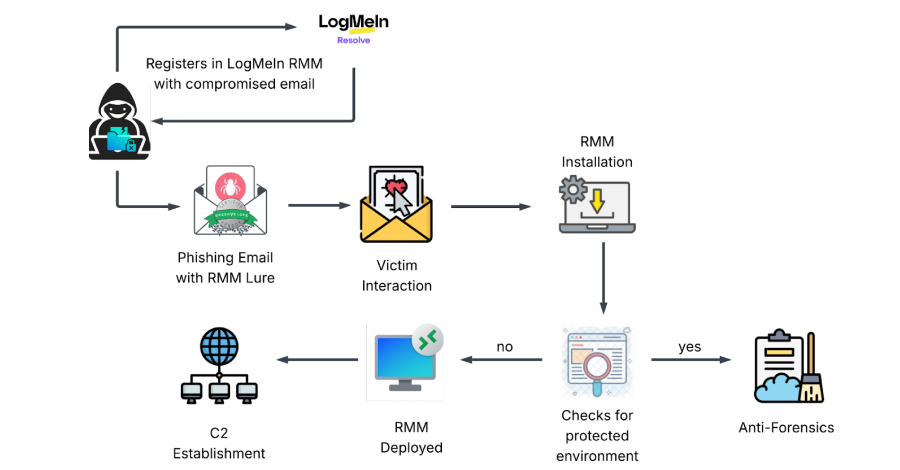
Phishing Attack Uses Stolen Credentials to Install LogMeIn RMM for Persistent Access
Cybersecurity researchers have disclosed details of a new dual-vector campaign that leverages stolen credentials to deploy legitimate Remote Monitoring and Management (RMM) software for persistent remote access to compromised hosts. "Instead of deploying custom...

Microsoft Flags Multi-Stage AitM Phishing and BEC Attacks Targeting Energy Firms
Microsoft has warned of a multi‑stage adversary‑in‑the‑middle (AitM) phishing and business email compromise (BEC) campaign targeting multiple organizations in the energy sector. "The campaign abused SharePoint file‑sharing services to deliver phishing payloads and...

New Osiris Ransomware Emerges as New Strain Using POORTRY Driver in BYOVD Attack
Cybersecurity researchers have disclosed details of a new ransomware family called Osiris that targeted a major food service franchisee operator in Southeast Asia in November 2025. The attack leveraged a malicious driver called POORTRY as part of a known technique...

Critical GNU InetUtils telnetd Flaw Lets Attackers Bypass Login and Gain Root Access
A critical security flaw has been disclosed in the GNU InetUtils telnet daemon (telnetd) that went unnoticed for nearly 11 years. The vulnerability, tracked as CVE-2026-24061, is rated 9.8 out of 10.0 on the CVSS scoring system. It affects all versions of GNU...