
Our Blog
“Welcome to the CISTCK Group Cybersecurity Blog! Dive into the dynamic world of cybersecurity with our expert insights, thought-provoking articles, and the latest developments in the field. Our blog is your go-to resource for staying ahead in the ever-evolving landscape of cyber threats. Explore topics ranging from threat intelligence and risk management to industry best practices and emerging technologies. Whether you’re a cybersecurity professional, IT enthusiast, or simply interested in safeguarding digital landscapes, join us on a journey of knowledge-sharing and discover actionable strategies to fortify your defenses. Stay informed, stay secure with the CISTCK Group Cybersecurity Blog.”

Seven Malicious Go Packages Found Deploying Malware on Linux and macOS Systems
Cybersecurity researchers are alerting of an ongoing malicious campaign targeting the Go ecosystem with typosquatted modules that are designed to deploy loader malware on Linux and Apple macOS systems. "The threat actor has published at least seven packages...

Researchers Link CACTUS Ransomware Tactics to Former Black Basta Affiliates
Threat actors deploying the Black Basta and CACTUS ransomware families have been found to rely on the same BackConnect (BC) module for maintaining persistent control over infected hosts, a sign that affiliates previously associated with Black Basta may have...

VMware Security Flaws Exploited in the Wild—Broadcom Releases Urgent Patches
Broadcom has released security updates to address three actively exploited security flaws in VMware ESXi, Workstation, and Fusion products that could lead to code execution and information disclosure. The list of vulnerabilities is as follows - CVE-2025-22224 (CVSS...

How New AI Agents Will Transform Credential Stuffing Attacks
Credential stuffing attacks had a huge impact in 2024, fueled by a vicious circle of infostealer infections and data breaches. But things could be about to get worse still with Computer-Using Agents, a new kind of AI agent that enables low-cost, low-effort automation...

Suspected Iranian Hackers Used Compromised Indian Firm’s Email to Target U.A.E. Aviation Sector
Threat hunters are calling attention to a new highly-targeted phishing campaign that singled out "fewer than five" entities in the United Arab Emirates (U.A.E.) to deliver a previously undocumented Golang backdoor dubbed Sosano. The malicious activity was specifically...

Over 4,000 ISP IPs Targeted in Brute-Force Attacks to Deploy Info Stealers and Cryptominers
Internet service providers (ISPs) in China and the West Coast of the United States have become the target of a mass exploitation campaign that deploys information stealers and cryptocurrency miners on compromised hosts. The findings come from the Splunk Threat...

Cisco, Hitachi, Microsoft, and Progress Flaws Actively Exploited—CISA Sounds Alarm
The U.S. Cybersecurity and Infrastructure Security Agency (CISA) on Monday added five security flaws impacting software from Cisco, Hitachi Vantara, Microsoft Windows, and Progress WhatsUp Gold to its Known Exploited Vulnerabilities (KEV) catalog, based on evidence of...

Google’s March 2025 Android Security Update Fixes Two Actively Exploited Vulnerabilities
Google has released its monthly Android Security Bulletin for March 2025 to address a total of 44 vulnerabilities, including two that it said have come under active exploitation in the wild. The two high-severity vulnerabilities are listed below - CVE-2024-43093 - A...

Hackers Exploit AWS Misconfigurations to Launch Phishing Attacks via SES and WorkMail
Threat actors are targeting Amazon Web Services (AWS) environments to push out phishing campaigns to unsuspecting targets, according to findings from Palo Alto Networks Unit 42. The cybersecurity company is tracking the activity cluster under the name TGR-UNK-0011...
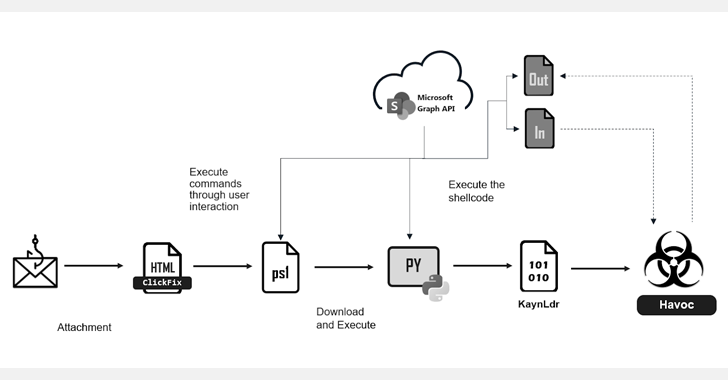
Hackers Use ClickFix Trick to Deploy PowerShell-Based Havoc C2 via SharePoint Sites
Cybersecurity researchers are calling attention to a new phishing campaign that employs the ClickFix technique to deliver an open-source command-and-control (C2) framework called Havoc. "The threat actor hides each malware stage behind a SharePoint site and uses a...